


Russia Has Sufficient Capacity To Produce Mineral Fertilizers For The Next Ten Years
Deputy Director of TD Azot Sergey Albrekht on the provision of the agricultural sector with urea and ammonium nitrate, export restrictions, innovative products and forecasts for the future
Deputy Director of TD Azot Sergey Albrekht on the provision of the agricultural sector with urea and ammonium nitrate, export restrictions, innovative products and forecasts for the future
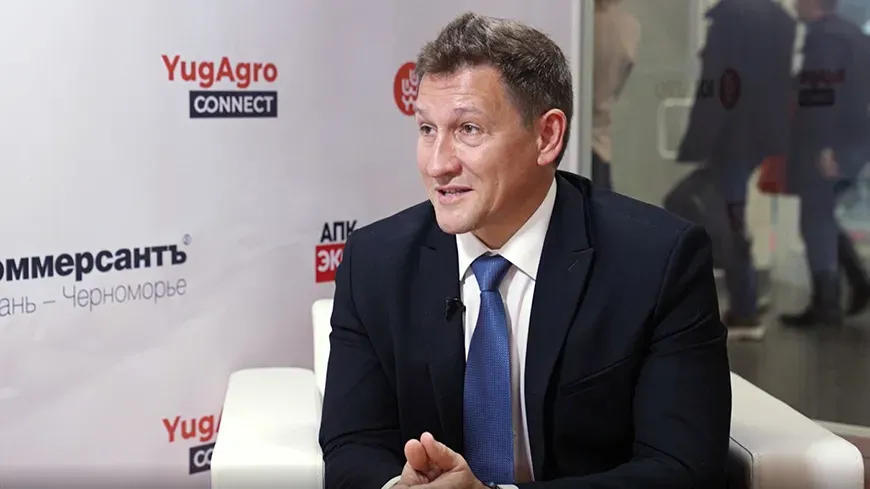
Today, the volume of mineral fertilizer production in Russia fully meets the needs of domestic agriculture. The Russian government regulates prices for urea and ammonium nitrate, and introduces export quotas to maintain a balance between shipment and consumption. Innovative products such as urea-ammonia mixtures are entering the market, which ensures higher crop yields and efficient application of nutrients to the soil. Deputy Director of the Azot Trading House, PhD in Technical Sciences Sergei Albrecht spoke about this and much more during the International Exhibition YUGAGRO 2024, which was held in Krasnodar on November 19–21.
Sergey Nikolaevich, what is the current situation with the production of fertilizers for agriculture? Are producers able to meet the needs of the agricultural sector?
Manufacturers are undoubtedly coping with the needs of the Russian agro-industrial complex. We regularly receive plans for the supply of mineral fertilizers for the needs of the domestic agricultural sector, these volumes are distributed depending on the capacity among manufacturers, so each company understands perfectly how much product it needs to supply to meet all the needs of the country's merchants and farmers.
Today in Russia the cost of credit money is quite high, and, unfortunately, many farmers simply do not have the opportunity to purchase mineral fertilizers. Therefore, this task is taken on by both manufacturers and some market players who are ready to take risks.
Since the main demand for mineral fertilizers occurs in the spring (sowing traditionally begins in the southern regions and ends in the northern ones), these three months will allow the entire volume of accumulated products (as well as the results of new production) to be used both for feeding winter crops and for sowing spring crops.
The production of mineral fertilizers in the country remains stable at all enterprises. Today, a balanced volume of supplies has been formed both for domestic consumers and for export. Currently, we produce a volume of mineral fertilizers greater than required within the country. Accordingly, all the surplus goes abroad.
How have the restrictions on fertilizer exports introduced by the Russian government affected fertilizer producers?
In 2022, an exceptional situation arose when export deliveries of mineral fertilizers reached such volumes that there was actually a deficit within the country. Then the Russian government even had to introduce quantitative restrictions on the export of ammonium nitrate, the most common and most effective nitrogen fertilizer. After that, the situation returned to normal.
Now, every six months, the government reviews the volumes of export deliveries and restrictions, but there is a certain positive aspect to this. The fact is that the prices for mineral fertilizers for the domestic market are set as maximum. This means that we, as producers, do not have the right to sell our products to agricultural producers above the set price. But, as a rule, export prices are higher than the maximum level within Russia, so enterprising companies and farmers who bought fertilizers at a low cost are ready to resell them abroad for completely different money. In order to avoid such abuses, quotas were introduced for the export of mineral fertilizers.
Today, the number of products for which these quotas are introduced is decreasing. From our product line, these are ammonium nitrate, urea and urea-ammonia mixtures.
As for urea, its production capacity in Russia is significant, and it is possible to cover all the needs of the domestic market in a month or two. Therefore, the lifting of export restrictions has already been discussed. In my opinion, it is necessary to leave quotas for ammonium nitrate, because during peak seasons, the agricultural demand for this mineral fertilizer is almost equal to its production. In addition to agriculture, there is another significant sector for the country's economy that needs ammonium nitrate - the mining industry. In this case, the quota mechanism is necessary to exclude possible games with deficit and price increases.
How are mineral fertilizers and their production technologies evolving qualitatively today?
There are traditional types of mineral fertilizers, in particular, nitrogen fertilizers (ammonium nitrate and urea), as well as an evolutionary product — urea-ammonia mixtures (UAM). The latter are now becoming increasingly popular. If ammonium nitrate is ammonium-nitrate nitrogen, which in our climate conditions is fully transformed into nitrogen absorbed by plants, then urea is used, as a rule, at fairly high soil temperatures. If we return to our climate conditions, the transformation of nitrogen from urea to nitrate and ammonium requires certain temperature and time factors. During this period, despite the fact that nitrogen in urea is 46%, some of it can be lost and the fertilizer will work less effectively.
Some time ago, a product was offered to the market - urea-ammonia mixtures, which contain all three forms of nitrogen. This allows the plant to receive prolonged nutrition - from the most easily digestible form of nitrogen to amide. In addition, this type of fertilizer is in liquid form, which allows it to be used without external moisture.
Today we produce about 200 thousand tons of UAN, the entire volume of which we sell to farmers in regions near Kemerovo, using delivery by road transport. The accumulation of urea-ammonia mixtures begins in September-October. In winter, this product crystallizes, begins to thaw in the spring, and together with the fresh product we get normal fertilizer in liquid form, which is applied during the sowing period.
In addition to the Kemerovo enterprise, we are launching the production of urea-ammonia mixtures at the Ammonium enterprise in the city of Mendeleyevsk in the Republic of Tatarstan. The capacity of the enterprise is up to 150-200 thousand tons of UAN per year, but everything will depend on the monthly demand. The production will fully satisfy the needs of neighboring regions for urea-ammonia mixtures. Because the volume of UAN that is currently produced in Russia is not sufficient, this market is developing, and our group of companies intends to continue working in this direction.
We closely monitor the balance of production and consumption of mineral fertilizers throughout Russia, we understand the problems that arise in each of the regions. For example, Siberia and the Far East, having ammonium nitrate production of approximately 1.6 million tons, consume approximately 1 million tons of fertilizers more. This is taking into account the nearest export to Mongolia, which depends on Russian production, as well as to Kazakhstan and Kyrgyzstan, whose capacity is insufficient to cover the needs of their agriculture. Some of the mineral fertilizers are exported from Siberia and the Far East to the countries of Southeast Asia.
In the Ural and Volga Federal Districts, ammonium nitrate production exceeds consumption by approximately 2 million tons per year. If we talk about the western cluster (Central, Southern and North Caucasian Federal Districts), where enterprises are mainly focused on satisfying export markets, the ammonium nitrate deficit there is about 1 million tons.
In general, the picture is as follows: enterprises of the Ural and Volga Federal Districts cover the deficit of Siberia and the Far East, as well as the western part of the Russian Federation. The main consumers of mineral fertilizers are, of course, the Southern and North Caucasian Federal Districts.
How do you see the future of the Russian agricultural sector through the prism of the activities of Azot Group?
We make various forecasts. It is gratifying that the current team of the Ministry of Agriculture of the Russian Federation supports the strategy of using mineral fertilizers in the agricultural sector, since this is an opportunity to obtain higher yields. Today, our country is a leading exporter of agricultural products, in particular, grain, we provide ourselves with many types of agricultural products, and in this prism, we make forecasts that allow us to say whether the industry will be provided with mineral fertilizers in the future. Today, we understand that the capacity for the production of ammonium nitrate is quite sufficient for the next ten years. Considering that we are developing, producing such products as urea-ammonia mixtures, there is a possibility that this will be enough for an even longer period.
